Trying to decide between a leased line and standard business broadband?
It is a common decision for growing businesses, and the choice is not always obvious. Both get you online, but they work differently, cost differently and suit different kinds of business.
This guide explains the difference in plain English, so you can decide whether the extra investment in a leased line is worth it for your business.
At Bytes Digital, based in Clevedon, we help businesses across the UK, including Bristol and the South West, choose connectivity that fits how they really work.
The Short Answer
For most businesses, standard broadband is enough. Full fibre broadband with a backup connection suits the majority of small and medium businesses.
A leased line is worth considering when your business cannot afford downtime, moves a lot of data in both directions, or depends heavily on its connection all day. It costs more, but it is built for those demands.

What Is Business Broadband?
Standard business broadband, such as full fibre (FTTP) or part fibre (SoGEA), uses the shared national network. Your connection runs over the same infrastructure as other homes and businesses in your area.
That is why it is more affordable and quicker to install. The trade-off is that it is shared, and most packages upload more slowly than they download. Our guide to the different types of business broadband explains each option in more detail.
What Is a Leased Line?
A leased line is a dedicated fibre connection between your premises and the internet. It is not shared with other customers, and it is built and supported as a business service from the start.
Think of it as a private road rather than a shared one. The capacity you pay for is yours, whatever everyone else is doing.
The Key Differences Between a Leased Line and Broadband
Speed
Leased lines are available at much higher speeds than standard broadband, with speeds of up to 10 Gbps. They can also be set to suit your business, such as 100 Mbps, 1 Gbps or 10 Gbps, and increased later without a new installation. Part fibre (SoGEA) typically reaches up to around 80 Mbps, and full fibre is much faster, but a leased line goes further still. Our guide to how fast a leased line is explains the speeds in more detail.
Upload and download speeds
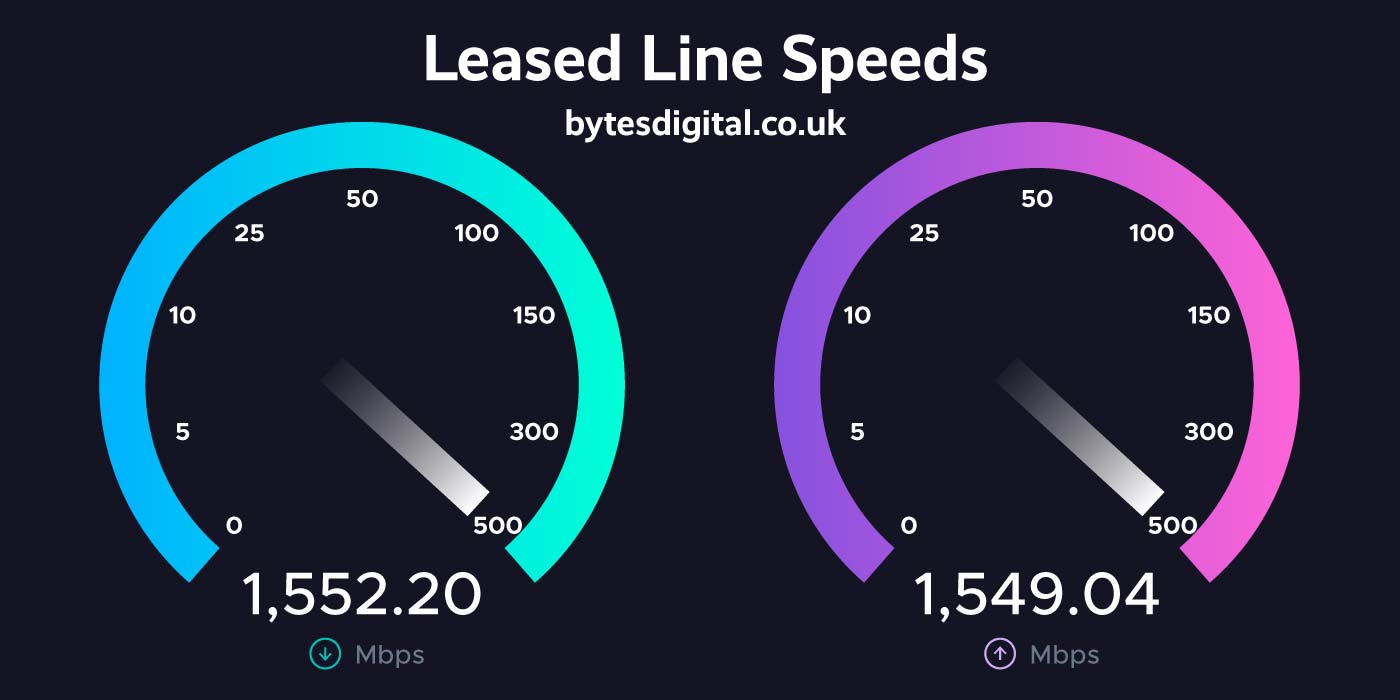
Most broadband packages upload more slowly than they download. A leased line typically gives you matching upload and download speeds. That matters if your team lives on video calls, sends large files, runs backups or uses hosted systems. We explain why in our guide to how much broadband speed your business needs.
Shared or dedicated
Because a leased line is dedicated, your speed is not affected by other businesses' usage, and you are guaranteed a minimum speed. With standard broadband, busy periods can slow things down, which is more noticeable on an industrial estate or in a busy business park.
Reliability and service commitments
Leased lines come with 99.99% uptime and stronger service commitments, including faster fault response. For a business where an hour of downtime has a real cost, that is a major part of the appeal.
Availability and installation
A leased line can reach locations where standard broadband is poor, which makes it a useful option for businesses with limited choice. It usually takes longer to install than standard broadband, because it involves dedicated fibre being brought to your premises. Availability depends on your address.
Cost
A leased line costs more than standard broadband. The question is whether the extra speed, reliability and support are worth it for your business. For many small businesses, they are not. For businesses that depend on their connection, they often are.
Advantages of a Leased Line
- Dedicated capacity. Not shared with neighbouring businesses.
- Matching upload and download speeds. Ideal for large data transfers and heavy cloud use.
- 99.99% uptime and stronger service commitments. Faster fault response when something goes wrong.
- Scalable speed. Choose the speed you need and increase it later without a new installation.
- Room to grow. Suited to businesses with a large or growing team.
- A solution where broadband is poor. Useful for premises with limited options.
Advantages of Standard Broadband
- More affordable. Usually a much lower monthly cost.
- Quicker to install. Often live far faster than a leased line.
- Good enough for most businesses. Particularly with full fibre and a backup connection.
- Flexible. Easier to change as your needs shift.
Which Should You Choose?
Standard broadband is usually the right choice if:
- You are a small or medium business with a team that uses cloud software and VoIP phones.
- A short period of downtime would be an inconvenience, not a crisis.
- Full fibre is available at your address.
A leased line is worth serious consideration if:
- Your business depends on the connection all day, such as hospitality, hosted systems or customer-facing services.
- You send or receive large amounts of data in both directions.
- You have a large team sharing the same connection.
- You cannot get a good broadband service at your address.
A simple test is to ask what an hour of downtime would cost you. If the answer is significant, a leased line, or at least a backup connection, is worth looking at. If speed is your main question, our guide to how fast a leased line is explains what each speed means in practice.
Is There a Middle Ground?
Yes. Many businesses get the resilience they need from full fibre broadband combined with an automatic backup connection, usually over 4G or 5G. If the main line fails, the backup takes over. Read more in our business broadband backup guide.
Our best broadband for business guide explains how the options fit together, and our fibre broadband page and leased lines page set out what we offer.
Why Talk to a Local Provider?
The right choice depends on your address, your team and how you work, which is easier to work out with someone who can check what is available and explain the trade-offs. As a Clevedon-based provider close to Bristol, Bytes Digital offers on-site support when it is needed, and one point of contact for broadband, networking, Wi-Fi and phones.
We are also independent, so we can compare options across networks and match them to your business. Broadband works best alongside managed IT support, so everything is looked after together.
Not Sure Whether You Need a Leased Line?
The simplest way to find out is to talk it through. Our team can look at how your business works, what you run over the internet and which options are available at your premises, whether that is in Bristol, the South West or further afield. Call us on 03331 301 021.
You can also see our business broadband page or use the online quote box below.
Frequently Asked Questions: Leased Line vs Broadband
What is the difference between a leased line and broadband?
A leased line is a dedicated fibre connection that is not shared with other customers, with matching upload and download speeds and stronger service commitments. Standard broadband uses shared infrastructure and is cheaper and quicker to install.
Is a leased line faster than broadband?
Generally, yes. Leased lines are available at much higher speeds, up to 10 Gbps, and the speed you pay for is dedicated to you, with a guaranteed minimum. You can also choose a speed that suits your business, such as 100 Mbps or 1 Gbps, and increase it later.
Do I need a leased line for my business?
Not always. Many small and medium businesses are well served by full fibre with a backup connection. A leased line suits businesses that depend heavily on their connection or move large amounts of data.
Is a leased line worth the extra cost?
It depends on what downtime would cost you. If an hour offline is costly, or your team depends on large uploads, it often is. If not, standard broadband is usually the better value.
What does symmetrical speed mean?
It means upload and download speeds are the same. Most standard broadband uploads more slowly than it downloads, while a leased line typically offers matching speeds in both directions.
Can I have a leased line and broadband together?
Yes. Some businesses use a broadband or mobile connection as a backup alongside their main line, so they stay online if one fails.
How long does a leased line take to install?
Usually longer than standard broadband, because dedicated fibre has to be brought to your premises. The timescale depends on your address, so it is best to ask early.